1-800-516-9373    |     info@catalinarug.com
RUG
FINDER

Width

Length

Type

Color

Price

SHOP BY ORIGIN

shim

POPULAR TYPES

shim

SHOP BY SIZE

shim

INFORMATION

Oriental Rug Designs – Part 1 Allover Floral Design

Posted By on April 14, 2013

Major Oriental Rug Designs

For this week’s post, I am beginning the first part of many series to come on Oriental rug designs. In this part one edition, I will brief you on the 2 major categories of rug designs and start the first subcategory which will be Floral designs. So let’s began…

Most Rug experts divide Oriental Rug Designs in to two major categories, Geometrical and Curvilinear. Geometrical Oriental rug designs are  usually woven by tribal and village rug weavers. The reason that these rugs are woven in villages is that geometrical designs are simpler and do not require detailed blueprints  to weave. For these designs,  the weavers use their memory and artisan intuition  to bring their ideas to life. You can think of the rug as their special canvas. Although the patterns come from the weavers memory, most of these patterns are past down from several generations of rug weavers. It’s simply amazing that these beautiful geometric rugs are woven without any guidance from blueprints. These geometrical design rugs are true showcases of the oriental rug weavers’ talents.

Now moving on to the 2nd main category, Curvilinear. This design is more difficult to weave and requires preliminary conceptualization. Curvilinear rugs are pre-designed with blueprints. These blueprints are created by the master rug designers, whose sole duty is to create rug blueprints. These master artists are known to have minimum of 20 years of experiencing as painters, and can only become rug designers when they are master painters. Because of their complexity and preliminary planning, rugs with curvilinear design are usually only weaved in factories in cities. And for this reason, curvilinear design rugs such as floral rugs can cost more than geometric design rugs. 

Here are the 2 major Oriental Rug designs with their perspective subcategories :

Curvilinear

      • -Floral Design
      • -Boteh Design
      • -Vase Design

Geometrical

      • -Geometric Design
      • -Herati Design
      • -Panel Design

(In the next several weeks, we will cover each design listed above)

Now, let’s start with the Floral design.

Floral Design

One of the Floral designs is Allover Floral. And just to recap, here is the category break down so far:

Curvilinear > Floral >Allover Floral

Allover floral designs have a classic and simple layout of flowers that are repeating all-over the rug (Thus their name allover floral). The floral motifs spread throughout the rug without any relation to a center piece. And these motifs usually fill the rug’s entire field. So with this flexible floral style there are many different designs possible.

Here is an example of a Tabriz Allover rug that shows this type of design.

Oriental Rug Designs including Tabriz Allover design without relation to a center point

Tabriz Allover design with repeating floral patterns


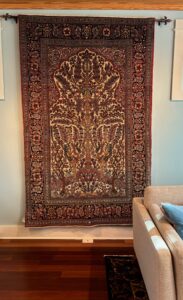
There is also another other type of All-over Floral rug that does have repeating floral pattern around a center point. With this design, the center point is implied but usually not present. And if you stay in a center of the rug you will see the same motifs around you, which are always symmetrical.

There are flowers throughout rug that are the same size and there are smaller sets of flowers in between with various shapes and colors. These combination of flowers have amazing harmony and great complexity that can keep you discovering new details in the rug for much time to come.

This is a great example of the design just mentioned.

Oriental Rug Designs including Allover design Tabriz Rug

Allover design with floral pattern that is related to a center point

As a bonus, I wanted to share an interesting philosophy about the environmental and societal effects on rug designs.

Rug industry and related  art like design and coloring  of Oriental Rug Designs was severely effected by instability of society and nature thought history of this hand craft.

As an example, during Safavieh dynasty the  artists had clear minds and comfortable time to focus on the art of design and weaving of  hand knotted rugs. For this reason rug designs and weaving process saw great improvement during those times. More dedicated rug designers came to light during and these individuals came up with new ideas and created  a variety of new designs. This renaissance of rugs effected Persian rug industry forever and caused an evolution of the art of rug making in Persia (modern day Iran) .

But sadly, when natural disasters occur or wars break out, the art of rug making is adversely effected. For example during the Mongols invasion of  Persia, the industry was almost halted momentarily for the first time.

To learn more about oriental rugs, see our blog archive on the right side of the page. Also stay in tune for part 2 of this series on Oriental rug designs, as we will cover the Medallion Floral Design.


Peshawar Rugs Must-Know Information and Review with Video

Posted By on March 20, 2013

This week I am going to talk about hand knotted Peshawar Rugs , also known as Chobi rugs. I will be covering the history, design, and ways to identify this particular type of rug.

Peshawar Rugs History:

The influences of migrations, invading armies, and trade have left Pakistan with a rich culture, which is visible in the arts and crafts of this region. It’s not known when the first carpets were woven in the Pakistan area, although it is claimed that weaving was probably introduced by ancient Scythians. In the 16th century the Mogul emperor Akbar established carpet-weaving workshops bringing Persian weavers to his imperial court. The carpets woven in these court workshops were very similar to Persian rugs in weave as well as in the designs used. Soon a new Mogul style began to emerge from the workshops. Later, in 1947 the new government in Pakistan recognized the need for industry and employment. Government subsidies were granted to the still-small Pakistani carpet-weaving industry, markets. Soon Pakistan emerged as one of the world’s leading manufacturers of  Hand Knotted Oriental carpets.

Peshawar is the capital city of the North-West Frontier Province, in Pakistan. The city located on the Afghanistan-Pakistan border has been an important center for trade and commerce in the region. The city is more famous for its traditional carpets or as more commonly known as Peshawar rugs.

Video: Hand Knotted Peshawar Rugs Review and Information

If you would like to get a better feel for these rugs, here is a helpful Video clip that provides information about Peshawar rug designs, colors, and how Peshawar Rugs are made. Also includes some examples of Peshawar rugs.


Loading the player…

Peshawar Rugs Design:

Peshawar  rugs are peculiar carpets that are characterized by:

• Artistic designs
• Subtle shifts in their color
• Materials can be wool or Wool and Silk

• Vegetable dye

Peshawar rugs example with vegetable dye colors Peshawar rugs with brown back ground and beautiful Cream in border and panels

Peshawar rugs are finely knotted with wool pile and cotton warp and weft threads. Silk and artificial silk is occasionally used in the pile to accentuate certain motifs. The Pakistani rugs are durable, take dye well, and are easily spun. The finest quality rugs are woven with local wool that has been blended with merino wool imported from New Zealand, Korea, and Australia. This imported wool contains more lanolin, has a longer staple, and is stronger, hence a more durable rug.

Two types of weaves are used in Pakistani rugs:

• The Mori weave
The Persian weave

In both types of weave the quality or fineness of the weave is expressed by a set of numbers in the form of a fraction- for example, 9/16 or 11/12.
The top figure is the number of horizontal knots in a linear inch; the bottom figure is the number of vertical knots in a linear inch. This way, the number of knots per square inch is easily computed by multiplying the two figures together.

The Persian weave, used in rugs with a wide variety of Persian designs, resembles the back of Persian rugs with approximately the same number of vertical knots in a horizontal inch as in a vertical inch, although the number of horizontal knots per inch is slightly less than the number of vertical knots per inch.

Persian –weave rugs may be woven either single or double knots. The quality grades range from 13/15 to 18/20, with intermediate grades of 14/16 and 16/18. The color combinations are esthetically pleasing and not harsh. Since the 1980s U.S. embargo of Iranian carpets, the production of Persian design Pakistani rugs has increased dramatically.

With conviction and by virtue of innovating newer designs, weavers, floral and geometric artwork, Catalina rug, Inc. is a leader in the Pakistan carpet/rug industry ensuring to deliver zero defective products. Furthermore, Catalina rug has an edge on specific washing and finishing brand new or antique finish rugs to meet the peculiar requirements of our valued clients.

shim

Why Catalina Rug?

Click Here For Details
shim

Client Feedback

"great rug quick shipping great seller"

Read more...

shim
shim

Follow Us On

facebook twitter